AppSec
Fix reachable findings with signed evidence.
Bring SARIF, CVE, dependency, IAM/RLS, or policy findings. Boetica returns bounded PRs, scanner deltas, rollback notes, and signed evidence packets.
Proof-native autonomous engineering
Boetica creates full-stack apps, continues real codebases, and remediates security findings — autonomously, inside isolated sandboxes, through governed pull requests on live GitHub and CI. Every change ships with a KMS/Sigstore-signed evidence packet your reviewers and auditors can verify: changed files, tests, checks, control-family mappings, and an attested trust boundary. And every result is backed by a signed benchmark scorecard — measured head-to-head against Devin, Pixee, Mobb, Veracode, and Copilot Autofix.
RepresentativeRepresentative end-state scorecard data. Values illustrate the signed-benchmark surface and are replaced by the live, re-verifiable feed before procurement review.
task
- await password.verify(body.password)+ await limiter.consume(requestIp)+ await password.verify(body.password)+ await audit.append(evidencePacket)
sarif:auth-throttle-77e3sha b7e4c195e1c8a4491f4e2a0evidence packet
hash 91f4e2a0 / SOC 2 CC6.6 / NIST AC-6 / 2026-06-21T19:42ZArtifact chain: a reachable auth-throttling finding becomes a bounded 4 files patch pull request; 12 tests and 3 checks pass; the change ships as a KMS/Sigstore-signed evidence packet, hash 91f4e2a0 chained to prior hash 5e1c8a44, mapped to SOC 2 CC6.6 / NIST AC-6, with human merge required.
Open the proof before you ask for access
A proven product should not only ask you to request access. Inspect the benchmark wins, a signed fix, the security review, and the procurement evidence first — then request access once scope is clear.
Built for your team
AppSec
Bring SARIF, CVE, dependency, IAM/RLS, or policy findings. Boetica returns bounded PRs, scanner deltas, rollback notes, and signed evidence packets.
Platform engineering
Run Create and Continue work through branch protection, review queues, budget caps, CI, and evidence — not an unsupervised agent.
Compliance engineering
Evidence Rooms package signed PR evidence, scorecards, control mappings, SOC2 artifacts, and procurement exports for auditors and CISOs.
Three paths, one trust boundary
Create
Boetica writes the spec, designs the backend, shapes the frontend system, scaffolds the repo, drives tests, and opens the governed PR sequence.
Continue
Boetica maps the existing repo, makes the change in isolation, drives tests, and explains what it touched before asking for merge.
Remediate
CVE, dependency, IAM/RLS, and policy findings become bounded patches, green checks, and evidence packets when controls are involved.
See the fix
See the task, diff, checks, policy decision, and signed evidence packet in one view — so you decide whether the work deserves to merge, before it ever does.
Open the evidence explorerSigned remediation PR
@@ apps/web/src/app/api/login/route.ts- await password.verify(body.password)+ await limiter.consume(requestIp)+ await password.verify(body.password)+ await audit.append(evidencePacket)
See the real product
Every screen below is the shipped Boetica workspace, rendered from source against seeded data. Start with the frame that shows the whole thesis in one view.
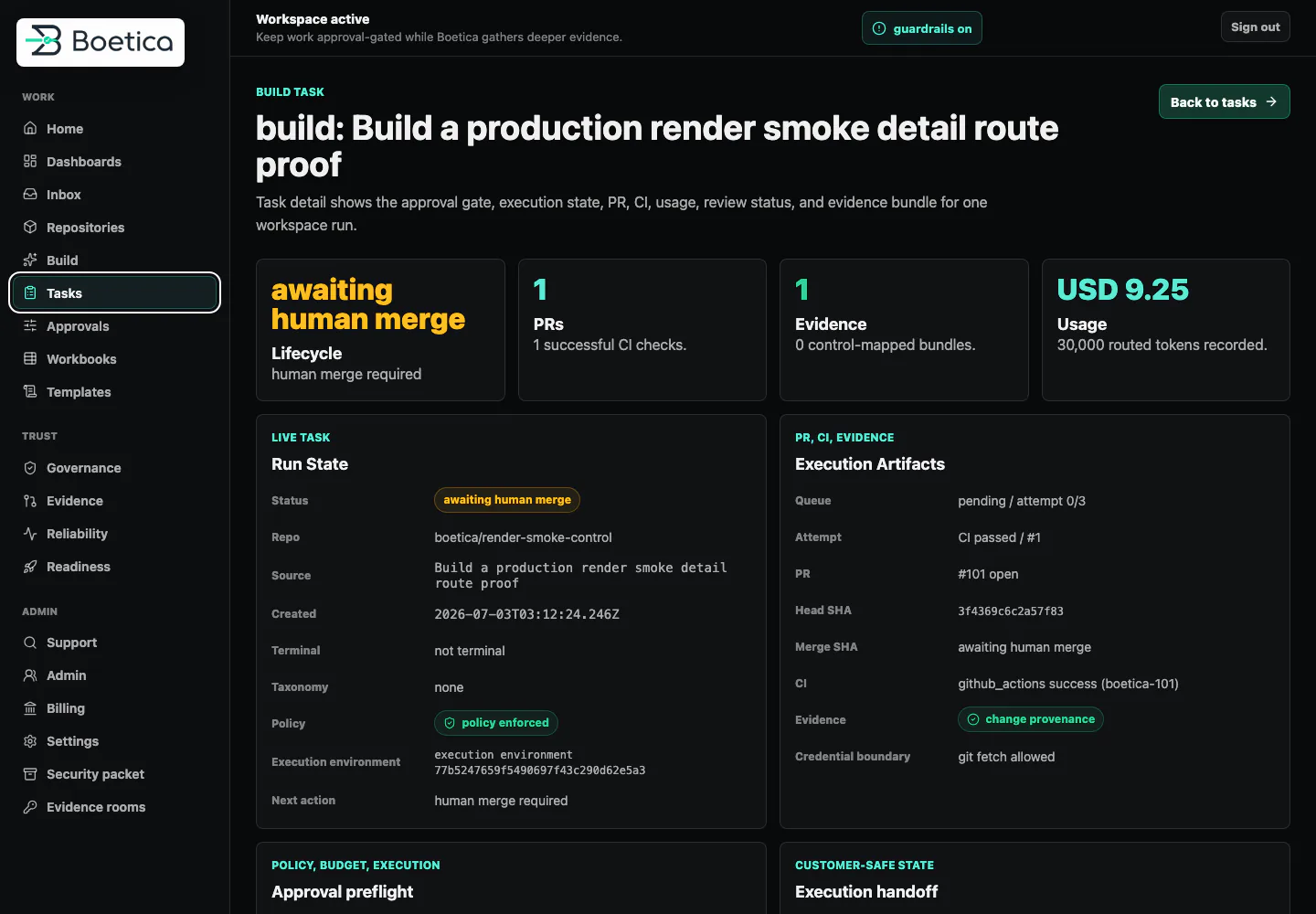
The whole thesis, one screen
An autonomous build becomes a governed pull request, its CI passes, and a signed evidence bundle is attached — then it waits at awaiting human merge, with cost and token usage on the same view. Autonomy you can let run, because it stops at your gate and shows its proof.
Open a fix and its proof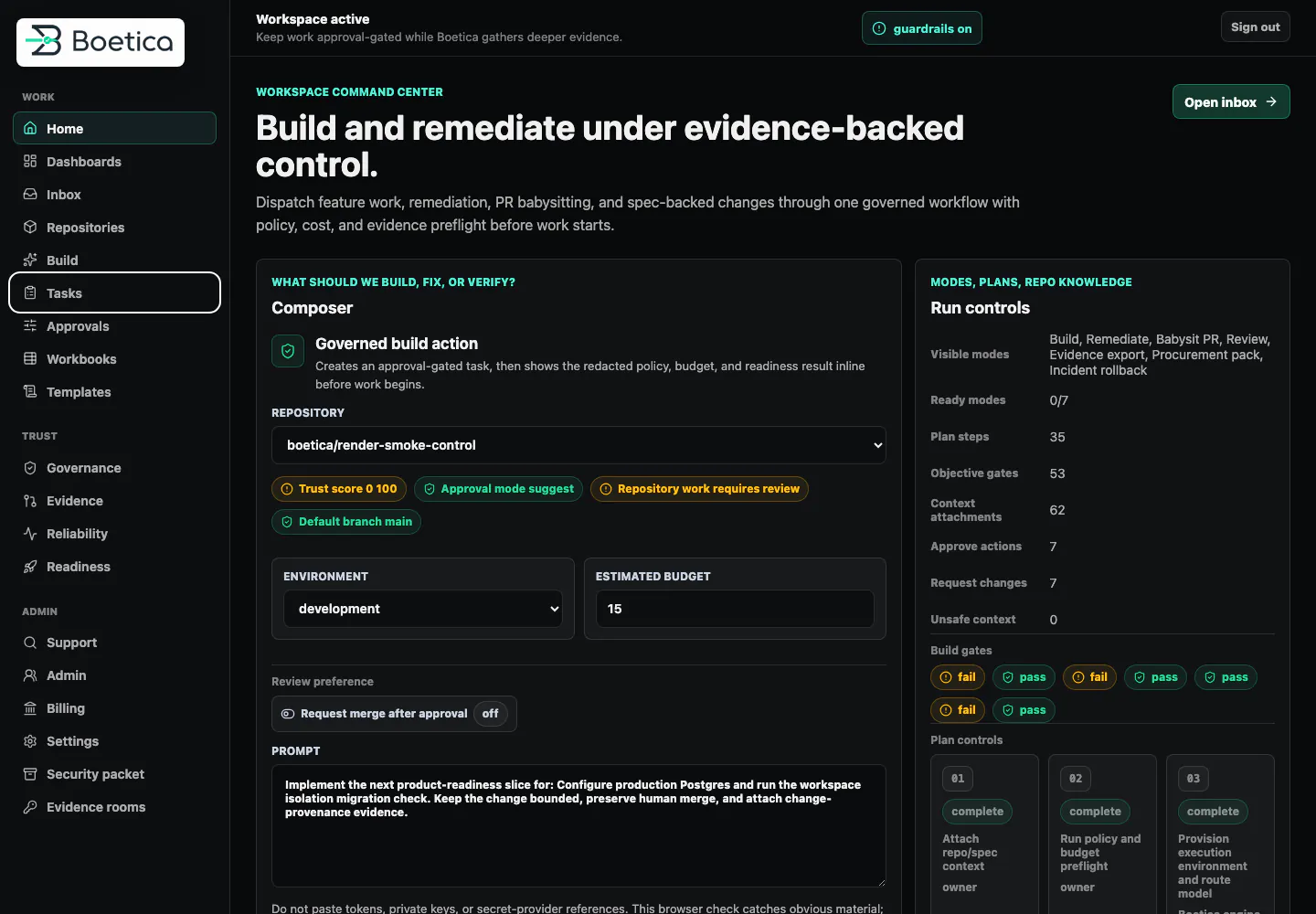
Command center
Compose a build or remediation with the run controls, budget, and preflight in one view.
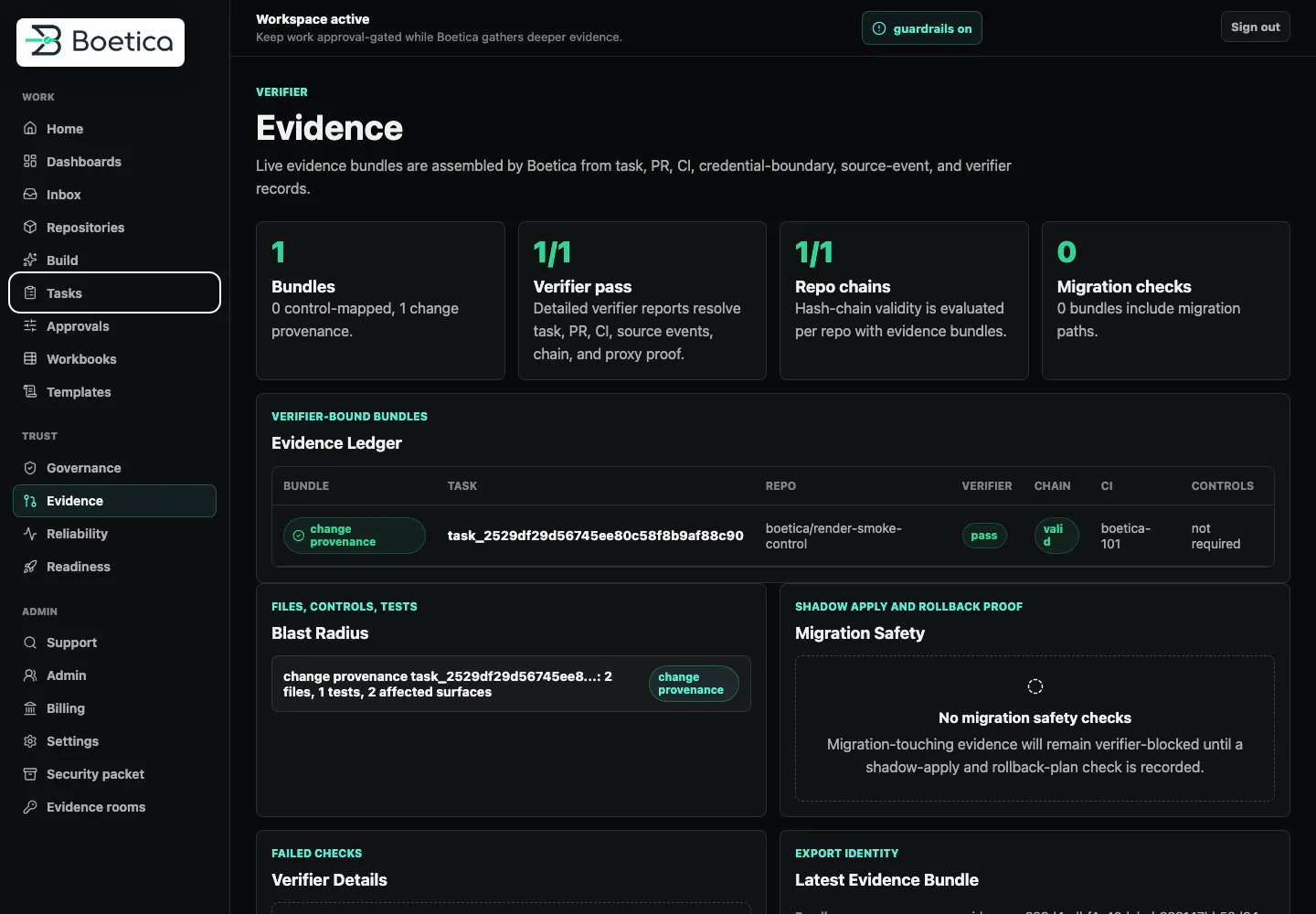
Evidence ledger
Signed evidence bundles per task — verifier passes, blast radius, and migration safety.
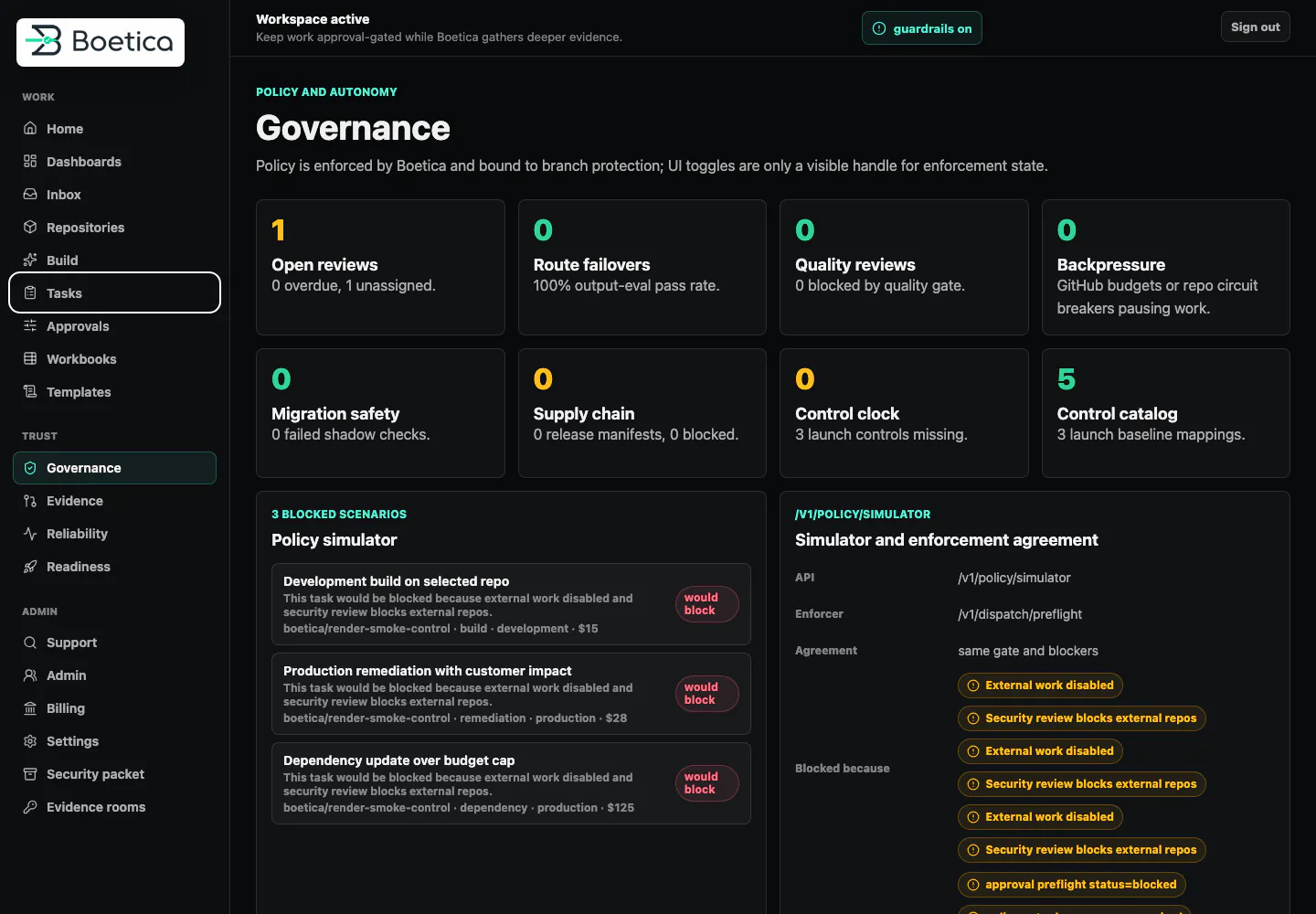
Governance
Policy is enforced and bound to branch protection — the simulator shows what would block.
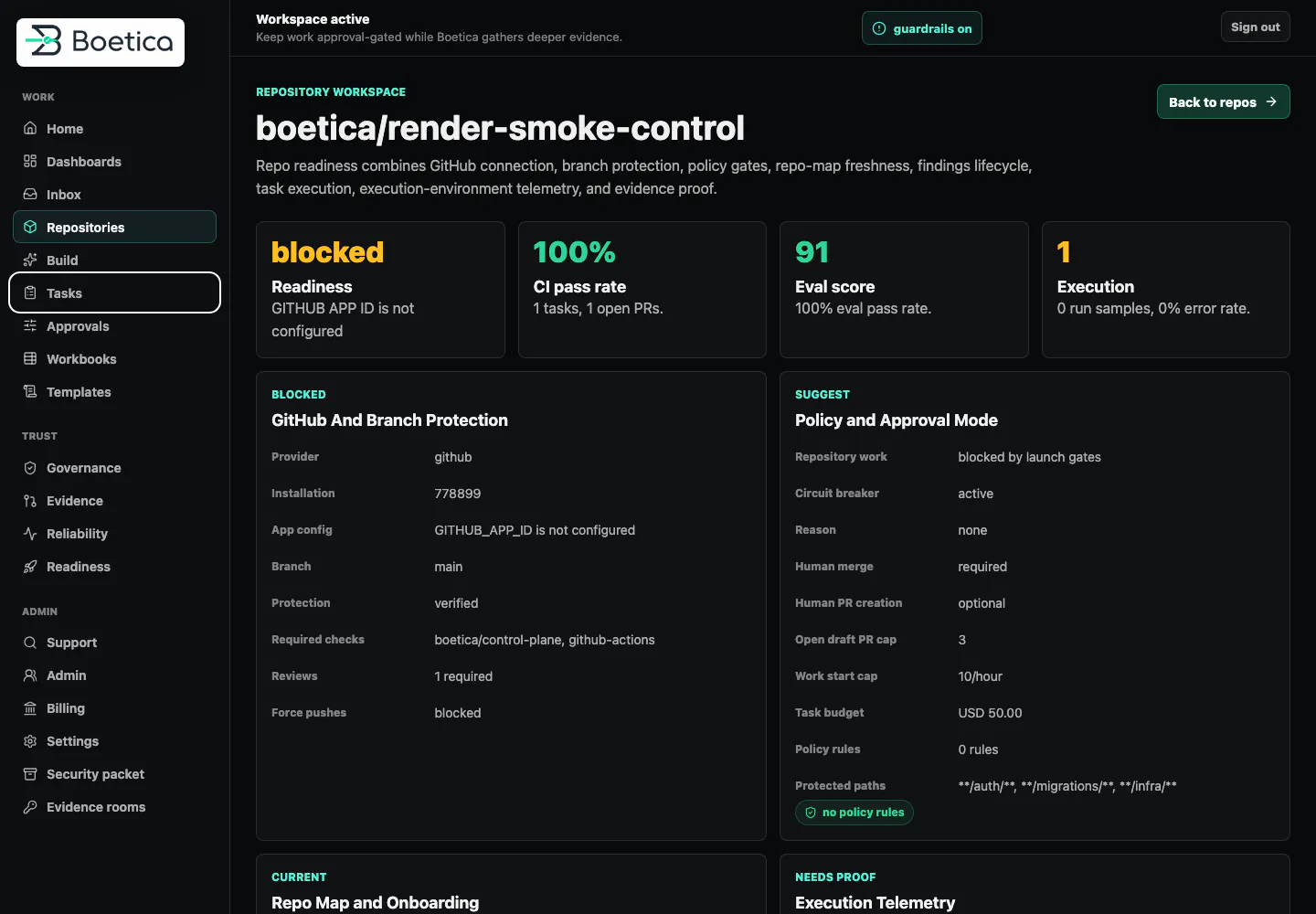
Repo readiness
Per-repo readiness, CI, and eval scores with branch protection and approval mode.
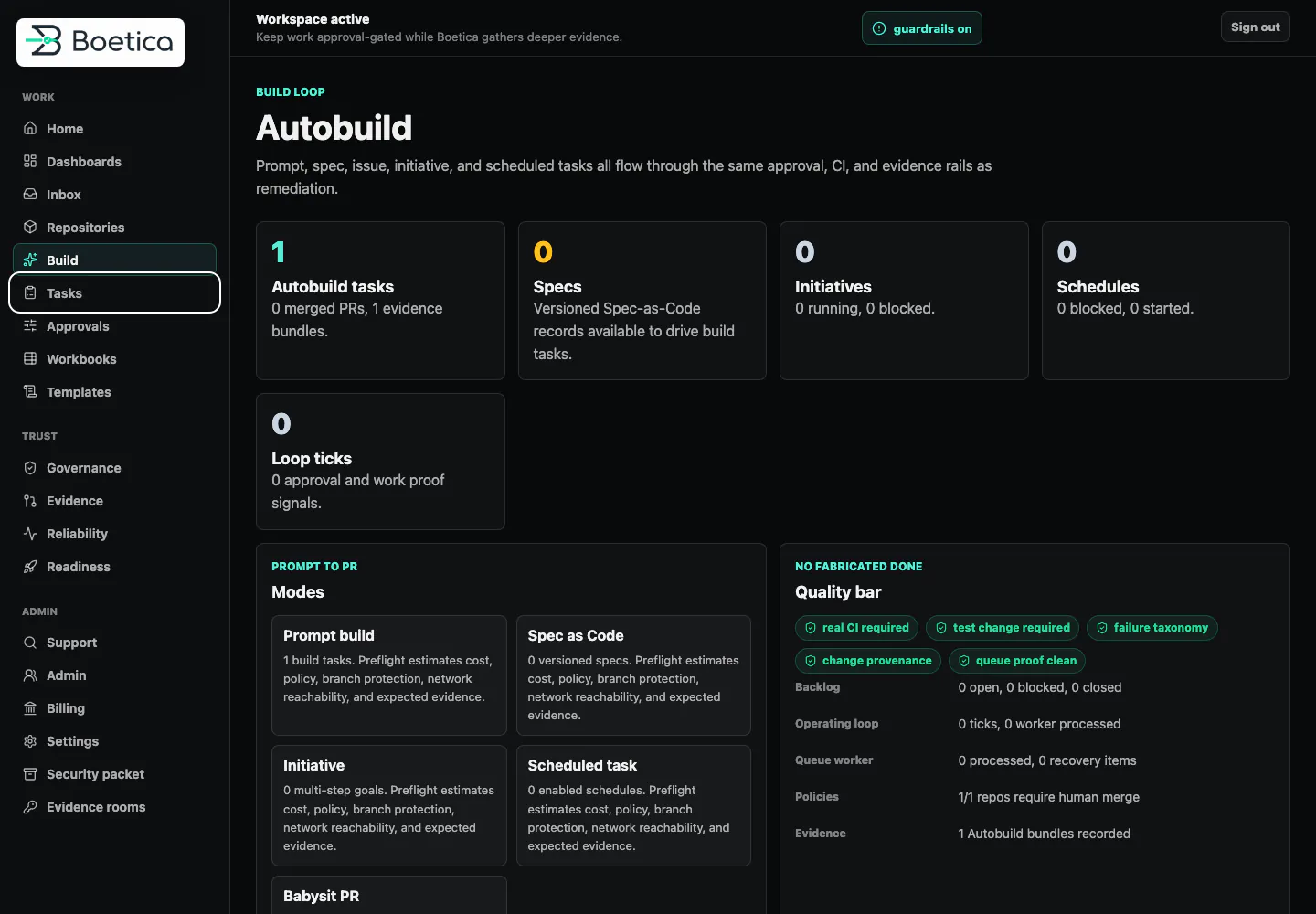
Autobuild loop
Prompt, spec, issue, and scheduled loops feed work through the same governed path.
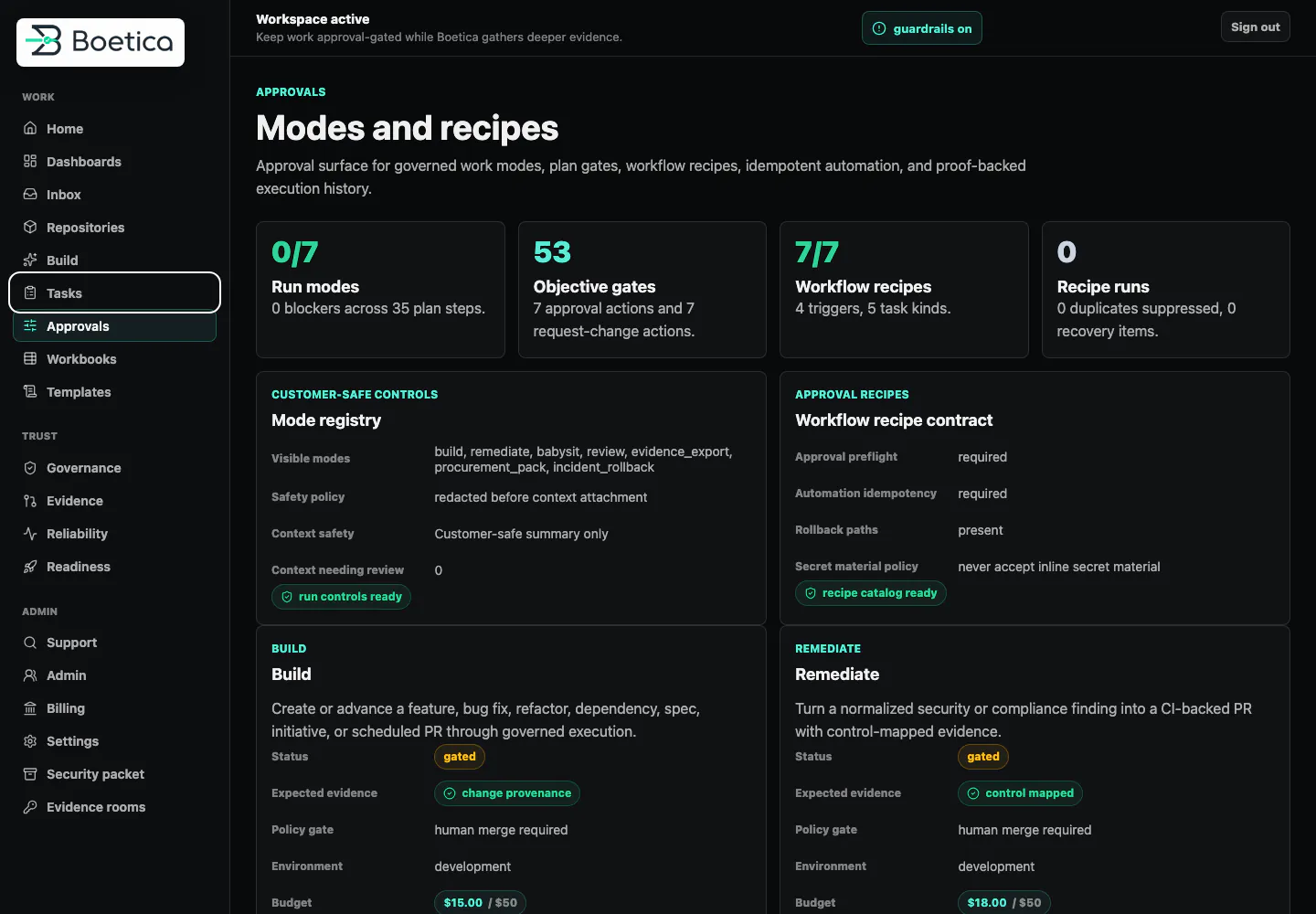
Controls and recipes
Run modes, objective gates, and workflow recipes behind approval-gated controls.
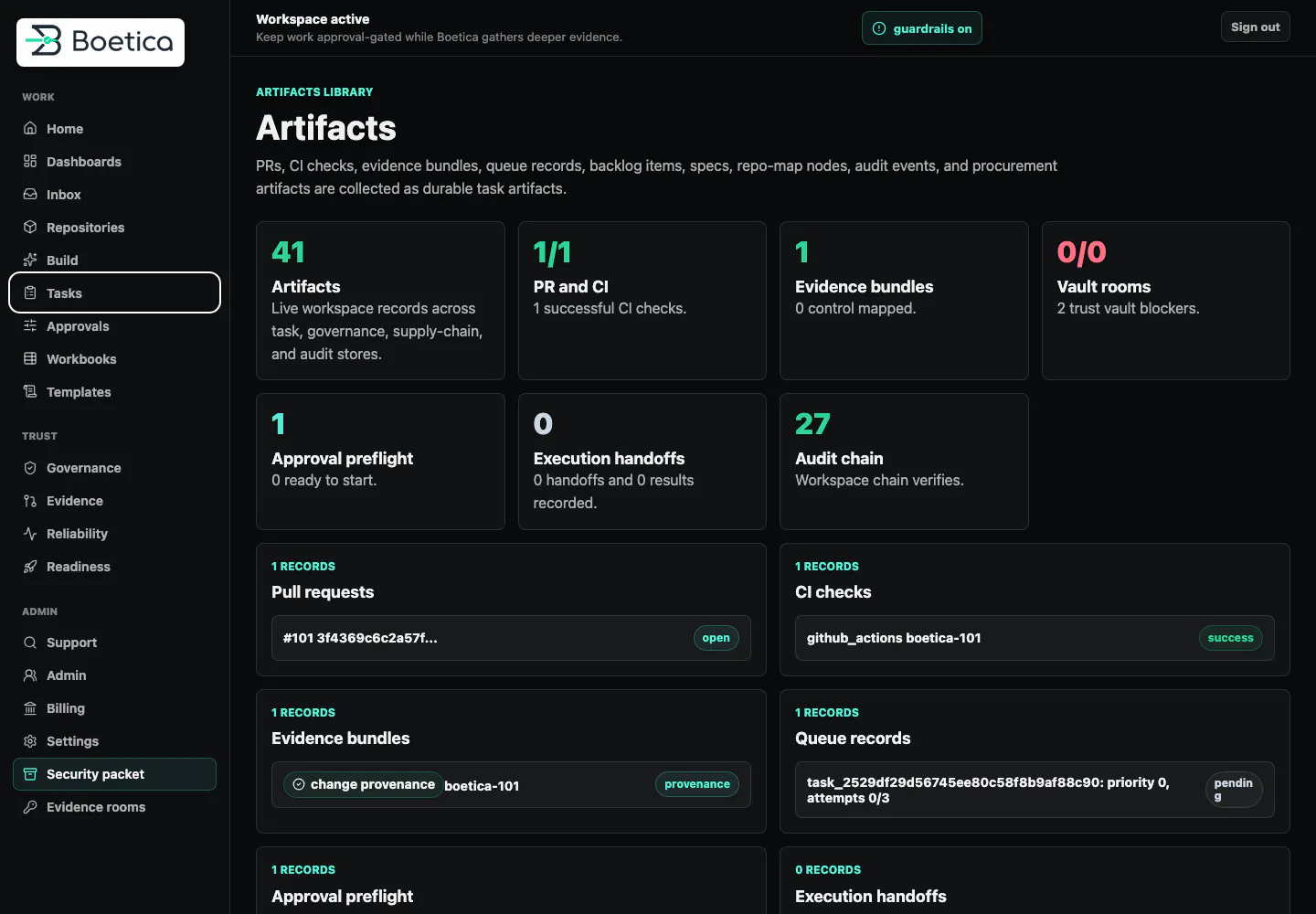
Artifacts
Pull requests, CI checks, evidence bundles, supply chain, and audit chain in one library.
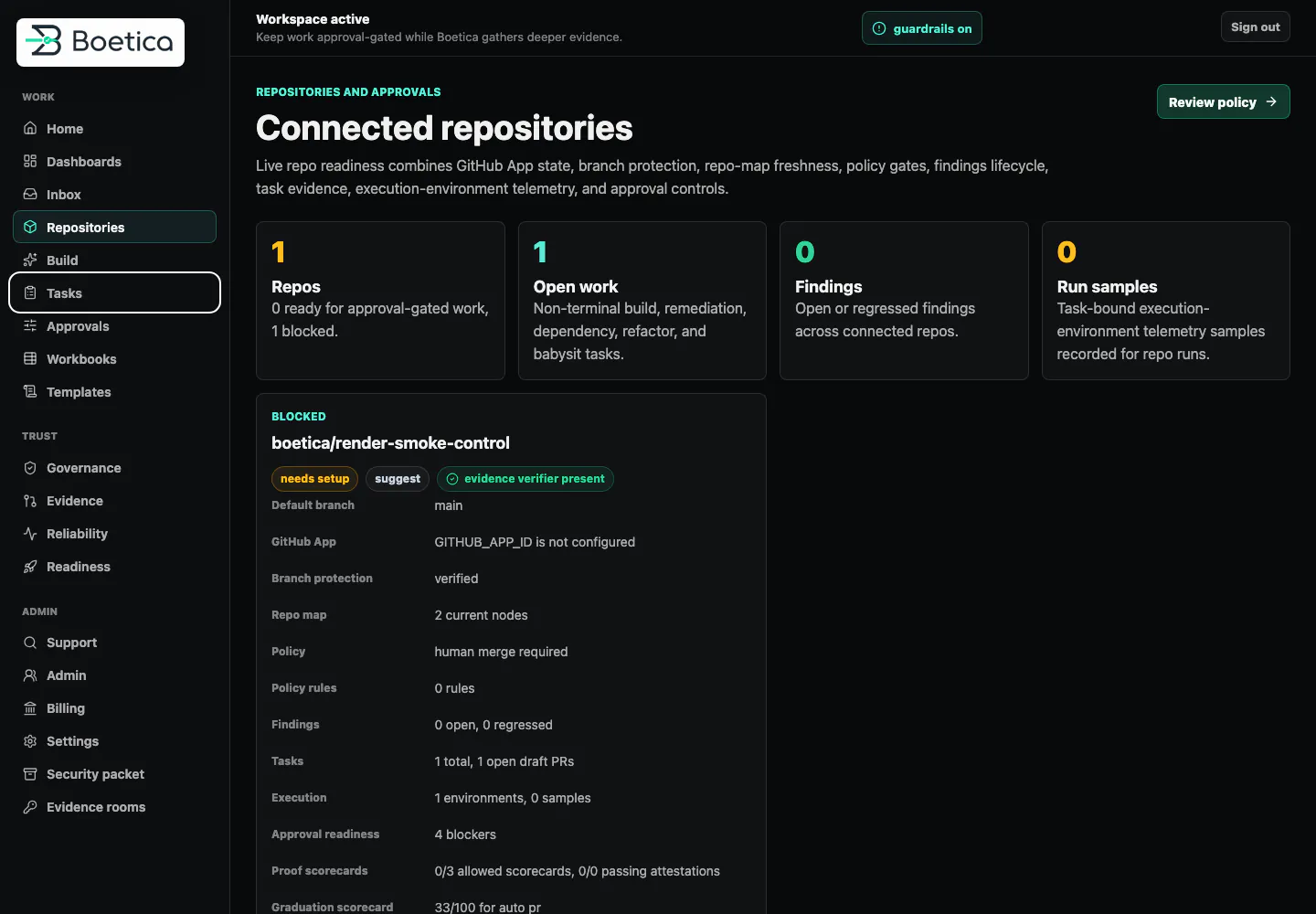
Connected repos
Every connected repository with its readiness, open work, findings, and run samples.
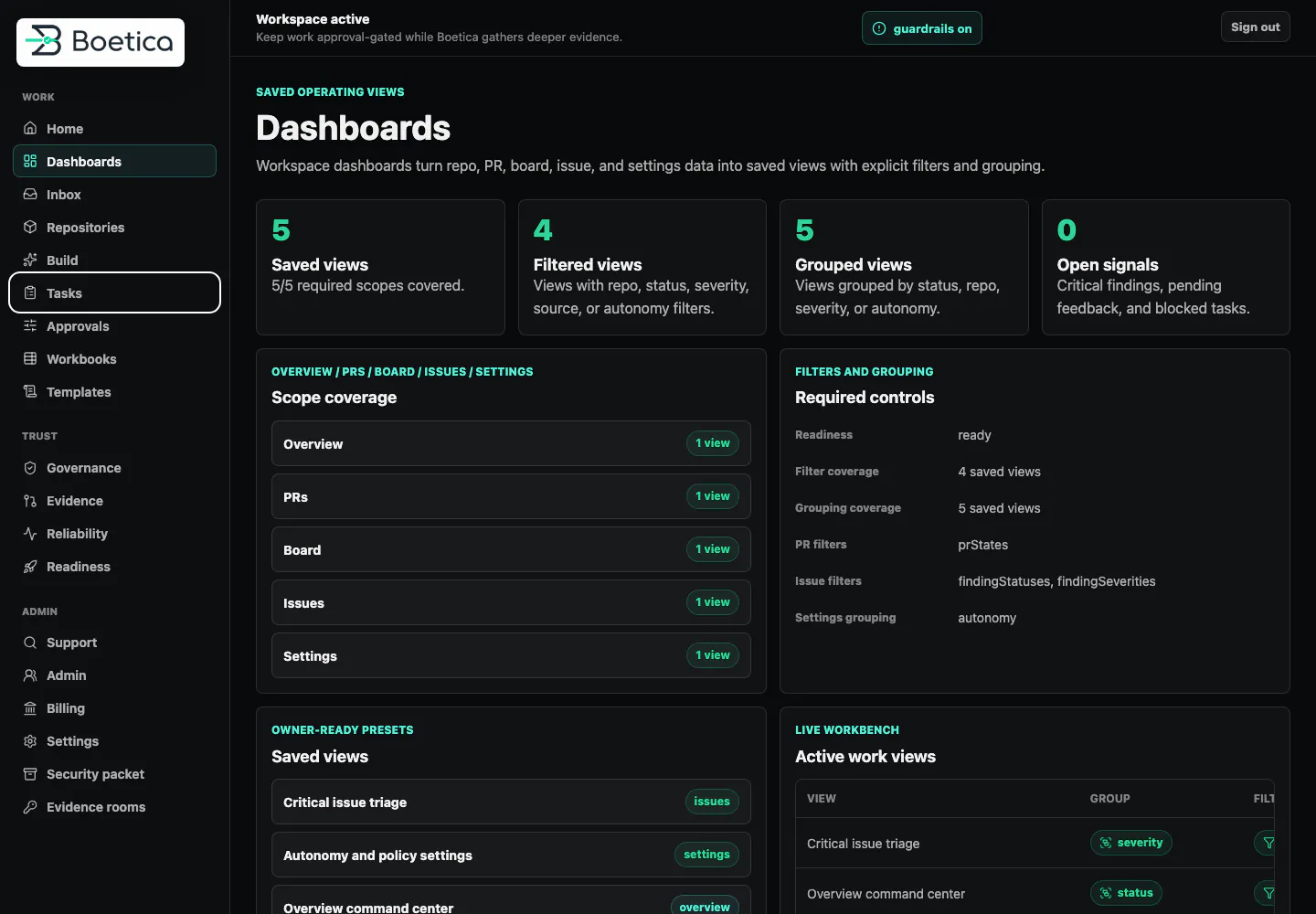
Dashboards
Saved, filtered, and grouped views with scope coverage and owner-ready presets.
Verifier-selected remediation
When Boetica remediates a finding, it does not ship the first thing a model emits. It generates several candidate fixes — each in its own isolated workspace — runs your verification gate on every one, and ships the candidate that proves it passes. The selector is never a model’s opinion and never a majority vote on text. It is the gate that either passes or fails.
best-of-N · verifier-selected
Rate-limit inside the handler, after auth
route-smoke: still 200 past threshold
Global middleware limiter on all routes
contract-gate: changed contract for callers
Per-IP limiter before password verification
unit-auth + scanner-rerun: clean, 0 net-new
Proven by the gate — shipped
The quality floor
Boetica runs cheap where it can and escalates where it must. If a fix fails the gate, the engine escalates to a frontier model and retries — automatically. And the remediation loop is self-correcting: when an edit does not apply, the engine is told exactly why and repairs it, instead of looping on broken output. The result is autonomous remediation that holds up — a floor under quality, not a ceiling on cost.
gate: FAIL
First attempt fails the verification gate. It is never shipped.
gate: PASS
The engine escalates automatically, retries, and clears the gate.
Signed benchmarks
Every win you see links to the signed, re-verifiable scorecard that backs it — measured head-to-head, with the dataset hash and signature attached.
bench:remediate
The verifier-labeled corpus
Every remediation Boetica runs is labeled by the gate that judged it — resolved or not, at what tier, merged or reverted. That is a growing corpus of verified outcomes. Competitors can copy prompts and routing tricks. They cannot copy a corpus of software fixes a real verifier already proved correct. That corpus is the moat, and it compounds every run.
See the signed benchmark surfaceRunOutcomeExample · verifier-labeled
gate-labeled| Task | Tier | Gate verdict | Fate |
|---|---|---|---|
| auth-throttle-77e3 | cheap → frontier | Gate passed | merged |
| sql-injection-2b41 | cheap | Gate passed | merged |
| idor-9c0e | cheap | Gate failed | reverted |
| dep-cve-5f7a | frontier | Gate passed | merged |
Where it fits
Boetica creates new applications and continues real codebases, but the output is still production software: specs, implementation, preview, CI, governed PRs, and proof attached.
Generic app generators
Boetica creates full-stack apps with backend architecture, frontend system design, tests, CI, preview deploys, and governed PR history.
General coding agents
Boetica keeps repo-bound work tied to policy, branch protection, CI, rollback context, and evidence before broader autonomy.
Scanners and GRC tools
Boetica turns credible findings into remediation PRs with reachability, control mapping, and audit-ready evidence.
Horizontal artifact platforms
Boetica focuses artifact creation on production software and the proof around it: apps, PRs, previews, evidence rooms, workbooks, APIs, and procurement packets.
Runs on a proven engine
The architecture on this page is not a roadmap deck. Boetica runs on a proven autonomous engine that is already live — repository events, credentials, and metering all in production.
Repository events land through a live GitHub App ingress, not a demo shim.
Runs authenticate through a brokered, per-install credential gate.
Usage is metered and capped per tenant — the same billing spine the product runs on.
The wedge, named
A model-arbitrated remediator writes the fix and lets a model decide it is good. Boetica arbitrates with ground truth — your tests, your CI, your gates — and keeps the proof.
Full platform
Boetica is a workspace, governance layer, evidence system, automation API, and procurement surface around autonomous engineering work. New applications, existing codebases, and remediation work all move through the same proof path.
App creation
Boetica creates backend architecture, frontend system design, repo scaffolds, tests, preview deploys, and staged PRs from scratch.
Workspace
Teams can start a governed run, see the preflight, follow attempts and CI, review evidence, and resolve blockers without leaving the workspace.
Control workbooks
Workbooks organize PRs, tasks, findings, controls, evidence, artifacts, connectors, budgets, and readiness actions into source-linked operator views.
Governance
Boetica enforces branch protection, review queues, policy DSL, budget caps, model-routing rules, quality gates, and PR-storm controls.
Evidence rooms
Evidence Rooms and Procurement Folios share PR evidence, audit records, security-review exports, readiness reports, and trust artifacts with scoped access.
Run API
Recipes, API-created runs, thread messages, signed webhooks, idempotency keys, and MCP all stay policy-bound and evidence-backed.
Procurement
Boetica packages sandbox, audit, evidence, supply chain, identity, data governance, provider terms, billing caps, reliability, and blockers for enterprise review.
Safe by construction
Each task gets its own hosted sandbox, narrow credentials, and locked-down egress before it can touch a branch.
Reviewers see the diff, tests, CI result, and rollback note in the same place they already work.
Every change carries provenance. Security and compliance fixes add control-family mapping when a control is touched.
Boetica can earn more autonomy repo by repo, with human review and branch protection enforced by policy.
How it works
Every claim links to the PR, diff, CI check, or signed packet that backs it. You inspect the proof, not a promise.
Human merge by default, progressive per-repo autonomy, budget caps, and branch protection — the limits are set before Boetica touches your code.
Every change ships evidenced. Security and compliance fixes are mapped to the controls they touch.
Evidence is formatted for your reviewers and auditors from the first commit.
Boetica is proof-native autonomous engineering. It creates full-stack apps, continues real codebases, and remediates credible security findings — autonomously, inside isolated sandboxes, through governed pull requests on live GitHub and CI. Every change ships with a signed evidence packet you can inspect.
Inside an isolated, single-task hosted sandbox with brokered credentials and deny-by-default egress — never on a developer laptop or a shared runner. The sandbox boundary is described on the trust-boundary page, and the marketing site has no access to customer repositories or production secrets.
Not by default. Human merge is the default path, and branch protection, policy gates, and budget caps are enforced before a run starts. A repository earns more autonomy only by policy, and autonomy is demoted automatically when quality signals drop.
A change summary, the diff, tests, CI status, the policy decision, a rollback note, and SOC 2 / NIST control-family mapping when a security or compliance control is touched — bound under a tamper-evident hash and KMS/Sigstore signed, so the packet is re-verifiable after merge. Walk one end-to-end on the See a fix page.
Start with the proof, not a request form. Open the signed benchmark scorecards, inspect a signed fix, and read the trust-boundary and procurement evidence. When the scope is clear, request platform access and pick the proof path your team wants to validate first.